
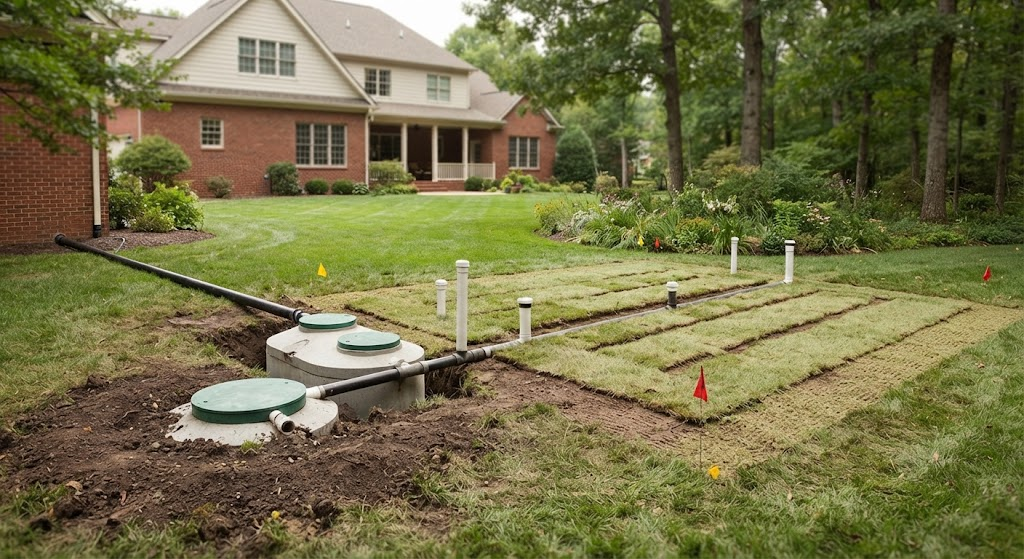
Choosing among septic system types begins with the land, not a catalogue. Soil permeability, groundwater depth, slope, available space, and local rules determine whether wastewater can be safely treated on a property—and whether a conventional system is suitable or an engineered alternative is needed.
Property Conditions That Guide Septic System Selection
Septic systems treat household wastewater on site, but their performance depends on what lies beneath and around the home. A soil evaluation examines soil absorption, depth to restrictive layers, seasonal groundwater, slope, lot dimensions, and separation from wells or waterways.
A percolation test helps measure how quickly water moves through the soil, though its results must be considered alongside the full soil profile and local requirements. Clay may drain too slowly, while very permeable sand can allow effluent to travel too quickly; rocky soil can limit the depth available for treatment. No single soil label determines the answer on its own.
In locations with a high water table or shallow soil, a conventional drainfield may not provide enough treatment distance. A qualified designer can use the findings to identify permitted options and protect nearby groundwater.
Conventional Septic Systems And Their Best-Fit Sites
A conventional system typically sends household wastewater into a watertight septic tank. Solids settle as sludge, oils form a surface layer, and partially treated liquid flows to a drainfield, where soil provides further treatment.
Gravity moves effluent through many conventional designs, keeping energy needs low. These systems are often a practical choice where suitable soil, adequate space, and appropriate groundwater separation are available. The drainfield must remain protected from vehicles, construction, and deep-rooted plants to preserve its function.
Chamber systems offer another drainfield format, using arch-shaped chambers instead of gravel-filled trenches. They can simplify material handling, but still require suitable soil and protection from crushing loads; they are not automatically appropriate for every site with shallow groundwater.
Alternative Septic Systems For Challenging Lots
When standard gravity-based treatment does not fit the site, alternative septic systems use different treatment or distribution methods. Their design can address specific constraints, but mechanical components may require electricity, inspections, and scheduled servicing.
Several common options illustrate how system design responds to property conditions:
- Mound systems raise the treatment area above natural ground, helping provide treatment depth where soil is shallow or groundwater is close to the surface.
- Aerobic treatment units add oxygen to support bacteria that treat wastewater more intensively; pumps and aeration equipment require regular professional attention.
- Drip distribution systems release effluent through narrow tubing, which can suit some slopes or constrained layouts, but depend on dosing equipment and maintenance.
- Sand filter systems pass wastewater through a designed sand bed before dispersal, offering an additional treatment stage where local conditions call for it.
- Constructed wetlands use gravel, plants, and microbial activity as part of treatment and need appropriate design, climate, and available land.
These approaches are not interchangeable fixes: approval depends on site testing, system design, and jurisdictional standards.
System Features Compared By Site Need
The comparison below summarizes typical applications, not a substitute for engineering review. Local codes and site results determine whether a system can be installed.
| System | Potentially Suitable Conditions | Planning Consideration |
|---|---|---|
| Conventional | Suitable soil and adequate space | Requires a protected, well-designed drainfield |
| Chamber | Sites approved for chamber-style dispersal | Soil absorption and load protection still matter |
| Mound | Shallow soil or a high water table | Requires a raised, carefully engineered treatment area |
| Aerobic unit | Some constrained or sensitive sites | Uses power and needs routine service |
| Drip distribution | Some sloped or space-limited properties | Relies on pumps, controls, and regular checks |
Purchase price alone does not reflect the full commitment. Installation complexity, electricity use, inspection schedules, pumping, and replacement components all affect long-term ownership costs, so compare lifecycle needs rather than selecting by initial expense alone.
Site Assessment And Long-Term Septic Planning
Before choosing equipment, confirm whether public sewer service is available and ask the local health department about permits, setbacks, and approved designs. A licensed soil professional or septic designer can assess drainage, groundwater, slope, and the area available for treatment.
Use that evaluation to compare viable systems, maintenance demands, and energy requirements with qualified installers. Keep installation records and follow the service schedule specified for the system; appropriate upkeep helps protect both the property and surrounding water resources.
Because soil and regulations vary from one lot to another, a licensed site assessment is the soundest basis for selecting a septic system. Consult a qualified septic professional for tailored design advice and any specialized installation work.